Sunday, April 26, 2009

Growth of Temples Worldwide

Today's Sunday School lesson was on the gathering of members in the early days of the Church, first to Ohio, then to Missouri. (I also talked about Nauvoo and Utah for continuity's sake.) Included in the lesson was this quote from Joseph Smith:

“What was the object of gathering … the people of God in any age of the world? … The main object was to build unto the Lord a house whereby He could reveal unto His people the ordinances of His house and the glories of His kingdom, and teach the people the way of salvation. … It is for the same purpose that God gathers together His people in the last days, to build unto the Lord a house to prepare them for the ordinances and endowments, washings and anointings.”


Keep that in mind, and consider Bruce R. McConkie, 1972:

“[The] revealed words speak of … there being congregations of the covenant people of the Lord in every nation, speaking every tongue, and among every people when the Lord comes again. …

“The place of gathering for the Mexican Saints is in Mexico; the place of gathering for the Guatemalan Saints is in Guatemala; the place of gathering for the Brazilian Saints is in Brazil; and so it goes throughout the length and breadth of the whole earth. Japan is for the Japanese; Korea is for the Koreans; Australia is for the Australians; every nation is the gathering place for its own people.”


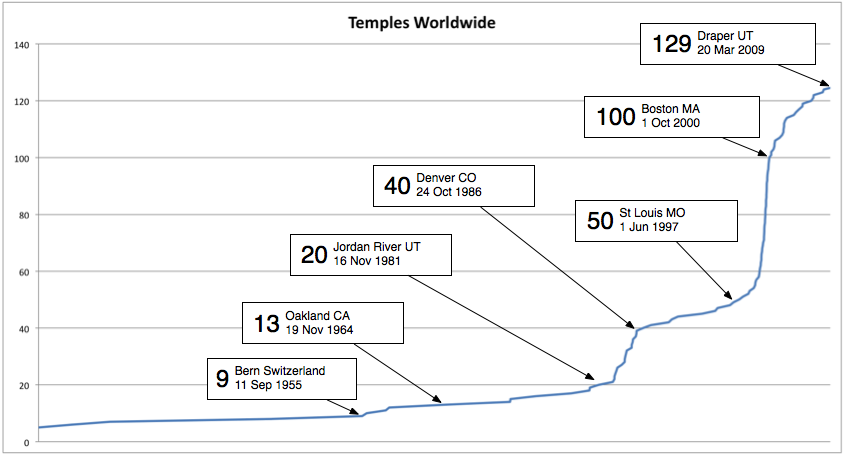
There must, then, be a clear correlation between the spread of temples around the world, and the spreading of the Church around the world. I grabbed the list of temples and plotted when they opened:
Temple Growth Callouts.png


The graph starts with the 5th temple, Laiee, Hawaii, in 1919; Excel doesn't like dates before 1900, and the rest of the graph illustrates the point. The Bern Switzerland temple (#9, 1955) was the first temple built outside of North America. (The first outside the US was #6 – Cardston Alberta, 1923.) It was shortly followed by Hamilton New Zealand (#11, 1958) and London England (#12, 1958).

In the early 80s, the number of temples doubled. This makes sense, given that in 1978, the Church suddenly found itself with a lot more members who could go to the temple.

The number of temples doubled again in the late 90s. (This is where the line goes straight up.) President Hinckley announced the new, smaller temple format and that they'd be doubling the number of temples in operation by the end of the millennium. It took just over three years.

There are currently 129 temples in operation, and another 16 have been announced or are under construction.

Sunday, March 15, 2009

To the Tune of “Rodeo”

Created while Elder Huckstep and I were roaming the streets of Worcester.

His palms are cold and sweaty
And he can barely speak.
He's camped out by the mailbox
For two and a half weeks.

Now it's "So long, girls! I'll see you!
I got my mission call.
We can date throughout the summer,
but I'm leaving in the fall!"

It's the doors you tract. It's street contacts.
It's Lamb of God videos.
It's two long years, will she still be there,
Waiting when you get home?

Well, it's tags and suits. It's faith in the fruits.
It's planting a goodly seed.
It's the love and the care, the testimony you share,
When they call you a mission'ry.


I thought there was a second verse, but I can't remember it.

Saturday, February 28, 2009

Benjamin Franklin's Daily Routine

Not bad. To bed by 10, up at 5. Daily planning and daily reflection.

Daily Routines: Benjamin Franklin

Wednesday, February 25, 2009

California Sunshine

I walked four miles today—walking from my car to my office and back more than once.
It all began last August, when Stanford raised the prices on their parking permits to almost $300 per year (for a C permit. An A permit costs almost $700.) Furthermore, massive construction projects on campus wiped out 800 parking spaces around the campus. I got myself a train pass to use the local commuter train when I can; but with my busy life, the train is simply not always the most efficient option. So I found a way to drive to work without having to pay for a parking permit. One of the streets on the edge of campus, Stanford Avenue, allows for free parallel parking. The only trick is the street is a mile away from the Hoover buildings, where I work. It’s a good thing I enjoy walking.

This morning I drove to work. I was very preoccupied with a project facing me when I got into the office, so I parked quickly and hiked to the office as fast as my legs could carry me. It was only when I neared Hoover that the question crossed my mind, “Did I lock the car?” I thought about the time it would take to walk back to the car to check and the urgency of the situation awaiting me at the office. I decided to finish my trek to the office, start the ball rolling on my project, then go check on the car as soon as I got a chance.

Half an hour later I was on my way out the door again, heading back to the car to check on it. I walked just as quickly as before because I didn’t want to waste any more time than I had to. It was warm enough that I left my jacket inside, yet a cool wind was blowing. Clouds drifted across the sky, clean, white and fluffy. The sun shone brightly in a vibrant blue sky and songbirds were trilling everywhere. I couldn’t help but enjoy myself as I made the hike back to the car.

Of course, the car was already locked when I got to it. The fact that I had remembered to lock it relieved me, but it made my mile-long walk pointless—but not useless. I walked back to work, drinking in the beauty around me. Work has been so busy lately that I rarely have had time to leave the office. I relished this unexpected treat.

At the end of work I walked back to the car and, once again, enjoyed the journey in the crisp air of sunset. My extra walk mid-morning really hadn’t been a waste of time. I got plenty of exercise for the day; I got a brief break from work. Most importantly I got to spend time in the sunshine of a beautiful California spring day. I honestly couldn’t ask for a better treat.

Friday, January 16, 2009

Everything I Really Need to Know in Life I Learned From Playing Blue

This was co-authored by Mike Manzer, and we posted it to mtg-strategy-l June 1, 1996. I didn't know I still had a copy of it; I'm glad I do.

A lot of it doesn't make sense unless you're familiar with Magic: The Gathering. There's still a lot of timeless wisdom here, even if you're not.


  • If you appear innocent, people will, at first, assume you're not dangerous.

  • People will only make that mistake once.

  • Never give up the element of surprise.

  • When faced with a problem, make it disappear.

  • If you can't make it disappear, take control of it.

  • If you can't take control of it, incapacitate it.

  • If you can't incapacitate it, keep it busy.

  • Keep your resources open.

  • Recycle (even if it's not yours).

  • Always have a backup plan.

  • If you mess with people enough, they get mad.

  • When people get mad, they make stupid mistakes.

  • Some people really are named Tim.

  • A little dash of water can do wonders to clear a cluttered battlefield...

  • Big flying things scare people.

  • Know your enemies.

  • Always look like you are in control.

  • Glasses are no fun.

  • If you poke people, they get annoyed.

  • If you poke people enough, they will die.

  • People usually get annoyed before they die.

  • Appearances are important.

  • You never get a second chance to make a first impression.

  • First impressions aren't everything.

  • Things never seem quite as cool as they used to be.

  • Appear strong where you are weak and appear weak when you are strong.

  • Mountains suck. So do Forests. Taigas are just evil.

  • Brute force is not all its cracked up to be.

  • The bigger they are, the harder they fall.

  • Things are tougher to stop once they've gotten started.

  • Play people against each other.

  • ALWAYS look like you know what you are doing.

  • Even when you try to make things fair, they won't be.

  • Never tap out.


Sunday, January 11, 2009

Personal Study Plan

I made a personal study plan this year. I started thinking about this sometime last year, and decided that the start of a new year would be a good time to write down some of my goals and formulate a plan.

After some prayerful pondering, I came up with the following goals:


  1. Read the Sunday School lesson every week.

  2. Read the Priesthood lesson every week.

  3. Review a talk from General Conference each week. (If you do this, you can just about review an entire Conference by the time the next one comes around.)

  4. Read the Ensign each month.

  5. Read the Limbaugh Letter each month.

  6. Write a talk each month.


In addition, I want to read A New Witness for the Articles of Faith, The 8th Habit, and some others. I didn't set concrete goals for when to finish those. Maybe I should. This is a first pass at this — next time, I'll keep what works and fix what doesn't.

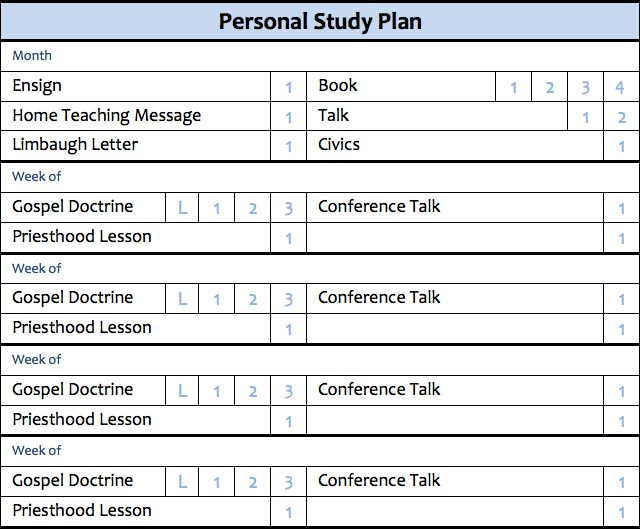
There are two months per planner-size page (this is just the top):

Personal Study Plan Top.png


The objective is to check off one box per day, wherever the box is.

Last year, it took me about three days to do justice to the reading for Gospel Doctrine. We'll see if that number gets adjusted as we get further into the Doctrine and Covenants. (The "L" is for weeks where I need to prepare a lesson.) One day for the reading for Elders' Quorum, one day reviewing a conference talk of my choosing, and one day where I'm free to choose whatever I want to study.

In addition to the weekly reading, there's monthly reading: two days in the Ensign (one specifically on the home teaching message for the month), one day to read the Limbaugh Letter, and four days to read longer books. The month is rounded out with two days to prepare a talk and one day spent studying civics — national history, fiat economics, biographies… It's kind of a wild card.

After putting two months on the page, I still had room for one more line. I decided to give myself some flexibility. Six times over a two-month period, my daily personal study can be listening to a podcast. Maybe I'll get lost wandering down the streets of Lake Wobegone. Maybe I'll test my awareness of current events. Or stick my head under the hood with Click and Clack. (If I'm feeling especially bold, I may even Meet the Press.) I figure I can make more time for them if they're a legitimate part of my study.

The part that I'm really pleased with is the last part:

Personal Study Plan Bottom.png


I'm giving myself six days of legitimately missing a day. I figure it's going to happen — some days, I just won't have the time, energy, or inclination to study. I thought this was an intriguing idea, and I'm kind of excited about it. I'm building a little bit of leniency (mercy? clemency?) into the goal. This is a motivational too as much as anything, and I can miss six days (over two months) and still check off a box.

Saturday, January 10, 2009

Apparently, I Chose to Dance

Another almost-four-year-old post.
The day will come that we look back on what we do today, and we will either smile at what we did, or we will regret what we didn't do. It's not whether I win or lose, it's that I'm getting back up. And I am going to have fun until the final buzzer sounds.
